

Part IV: Am I Really That Different?
Those who live with Erb’s palsy/BPI know what this question means. More importantly, they surely know how it feels to suppress it for years, until one day, there is no other option but to stare reality in the face and say: I will change you before you change me (into something I don’t want to become).
Factor: Realization
Before staring into reality’s deep and blackened eyes, I first had to come to realization. The Merriam-Webster Dictionary defines “realize” as to conceive vividly as real; to be fully aware of.
The closest I ever came to realizing that I had a long-term nerve injury were the moments when my father would desperately try to remind me that I needed to do my exercises.
Looking back—from the years when I first started physical therapy to my early twenties—I can say that I was aware of my condition, but I was never fully invested in it. That’s ironic, considering that I’m perceived (and perceive myself) as a person of strong integrity and full dedication to everything I do in life.
If I could weave a sentence to describe my attitude toward Erb’s Palsy, it would mostly consist of synonyms for ignore. I’ve done a lot of introspection and spent countless hours discussing my injury with my close ones and with God, yet I don’t think I’ve ever found the correct answer to why I acted that way.
An outsider—or perhaps a trauma expert—might say that I was trying to avoid experiencing the negative aspects of my injury. However, the more I look back, the more I realize that I already answered myself in what I wrote before: I had other priorities. I had a life to live, and I didn’t want to let Erb’s Palsy stop me.
The problem wasn’t that I loved living. It was that I loved living to the point of exhausting myself. For many years, sleep felt like a punishment. I would spend my days going to classes and studying, and my nights writing, reading, listening to music, watching movies, discovering new artists, talking to God, and seeing my friends.
The process of realizing that I had a real problem to face happened gradually—yet at times, it felt like a non-stop catapult hurling burdensome questions, stares and frustration at me.
The Questions
2009, Kumanovo, Nightclub
“Does this bother you?” I asked my then-boyfriend in the middle of the nightclub, just before he leaned in to kiss me. Confused, but with a warm smile on his face, he replied with a question of his own: “Why would it bother me?” Then he took my right hand in his palm and hugged me.
I guess insecurities hit differently when you’re sixteen and standing in front of your first teenage love. I felt both accepted and ashamed—ashamed of my own stupid question.
2011, Kumanovo, At a boutique
While being convinced not to disappoint my mom’s (and an entire generation of high school graduates’) expectations, I stood frustrated in the middle of a boutique, wearing a white-and-black polka-dot dress with a Hide the Pain Harold face.
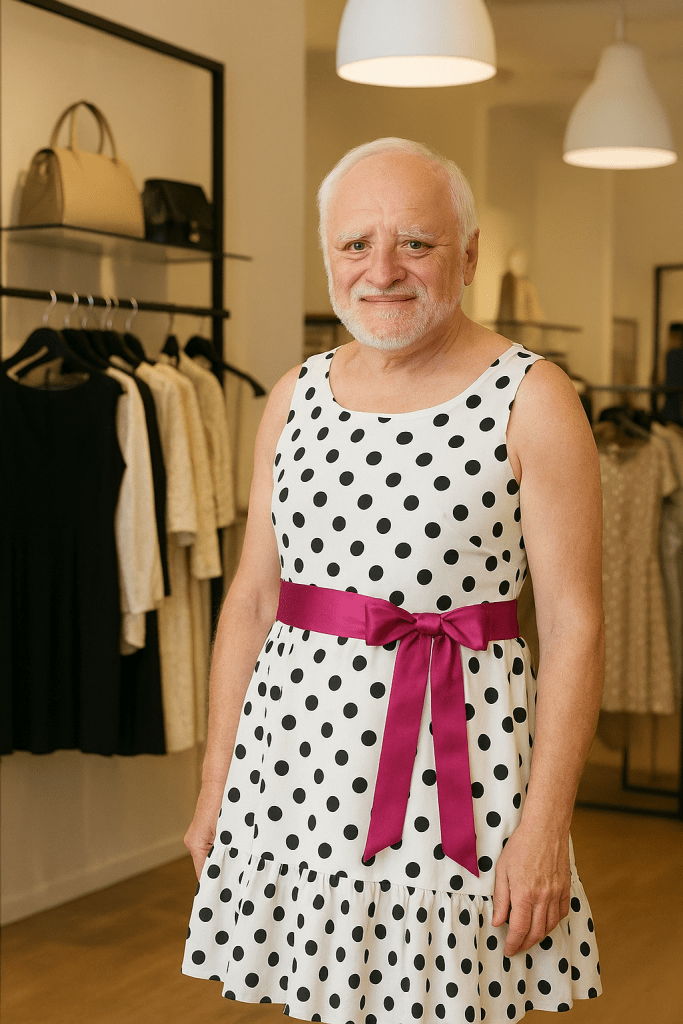
Made with AI, based on a human story.
The dress itself wasn’t that ugly (except for the magenta ribbon and the ruffles, and the fact that it was on me), but all I wanted was to feel like myself at the graduation party. In other words, I wanted to wear jeans, a black corset, and simple black heels.
I shared my wish with my mom, already preparing to defend my style thesis if she said no. Then came a hesitant, half-whispered line that slipped out before she could stop it:
“But… wouldn’t you need a shawl as well…?”
Haroldina couldn’t hide the pain anymore. I held back my tears, but the moment stayed with me well into my late twenties.
There’s a song by Toshe Proeski that says:
“With words you never said
Or said, but never meant
Just as sure as stars above
You’re gonna hurt the ones you love.”
I know she said it out of love and protection. She’d seen the stares just as much as I had. The difference was that I was trying to forget them. It took me long talks with God to forget those words and years to regain my confidence.
To parents, from a (grown-up) child with Erb’s palsy:
Do not pass your insecurities and fears on to your child.
Do not overprotect your child.
Do not make them feel different.
Do not doubt they can confront the world.
Do not pity them.
Do encourage them.
Build them up.
Remind them that their worth lies in their heart, not in their appearance.
2012, Geneva
“Ñaña, are you doing the exercises? Your forearm is still contracted.”
Every time my dad asked me this, a wave of sadness and guilt would overwhelm me. I knew he was right and could tell that I wasn’t exercising as much as I should, hence the contracted arm. On the other hand (pun unintended), I would rather talk about other things, because I already knew.
Like my mom, he was reminding me to protect me from further complications. His caring words started affecting my self-awareness, which only caused more remorse. He had been my physical therapist throughout my teenage years, and now, as a 20-year-old, I didn’t feel as disciplined as I did when he was back home.
2014, Greece, At the beach
“Ana, have you been playing table tennis, maybe?” a relatively new friend asked me while we were playing beach tennis.
“No,” I smiled, half-wondering why he was asking—and then I immediately realized. It made me chuckle. Honestly, it was one of the most innocent questions I’d ever gotten about my arm.
Oh, okay… then there was my sincere colleague, who once said, “Take your hand out of your jacket! You’re creeping me out—it’s like you don’t have an arm.”
“Mary, I have an arm,” I said. “It’s just shorter. I have Erb’s palsy.”
The look on her face? Pure, hilarious regret—like she had just accidentally insulted a professor she was counting on for a passing grade. A whole day of apologies, facepalms, and awkward stares didn’t calm her down, so I had to step in with more awkwardness and a dose of my dark humor.
She ended up becoming my bestie at university.
2016, Kumanovo, By the river
“Do you know you’d be prettier if you didn’t hide your arm?” My gorgeous friend with a once-in-hundred-year beauty asked me, right before taking a photo of me on a huge rock by the river. I smiled; it was easier to do that than explain that if I didn’t lean on my weak arm behind my back for the pose, I’ll end up in the river.
The Stares
I’m not talking about the mean girl stares. I’m talking about “Awww, are you okay?” “What’s happening with her arm?” prolonged looks, starting with curiosity and continuing with a primitive “no-one-taught-me-as-a-child-not-to-stare.”
I remember each and every one of them, with the latest happening only a year ago, when a young couple in their early twenties commented while whispering and sharing an inside joke while staring at me. The difference between this one and the earlier ones was that I felt sorry for them, and felt grounded and calm about who I am.
Next time someone stares at you not out of curiosity but out of rudeness or malice, remember:
“For You created my inmost being;
You knit me together in my mother’s womb.
I praise You, for I am fearfully and wonderfully made;
Your works are wondrous, and my soul knows it well.”
Psalm 139:13–14
The Frustration
Have you ever tried to open your palm and feel the urge to roar because no finger would move? Been there, done that. I still do it, but with roaring progress, instead of weakness.
However, the frustration isn’t just one thing. Personally, I’ve struggled with playing all the sports I like, playing the guitar, holding the fork and knife in a restaurant without fearing I’ll poke myself in the eye, or worse, drop the knife on a passing waiter’s foot. What would I say to him? “Oops, sorry! You’ll get used it! By the way, I know some great exercises for nerve pain, in case I poked your peroneal nerve.”
None of this happened, but gliding through and overcoming the anxiety of the “it could’s” took me a decent amount of time.
There are hundreds of stories like this that I can share but let’s keep some for the next part.
Everything that you read in this part, I want it to be a reminder to you that I know how you feel. I, better than any doctor, neurosurgeon, OBGYN, physiotherapist or massage professional, know what it’s like to ask yourself, “Am I really that different?”
Maybe you are. I still haven’t met you. Maybe God intended you to be different. Not because you have an injury, but because that injury has taught you empathy, resilience, what weakness feels like, what anger in tears tastes like, what fear feels like boiling through your lungs and heart. Most of all, you’re probably different because you have a precious human capability: to give a hand to a suffering living being, even on days when it feels like you could use an extra one.
To whomever is reading this and living with Erb’s palsy or BPI: I love you. I am grateful you exist. I believe in your calling to raise awareness and become a stronghold for those whose fortress has come down. Take care of yourself and never, ever doubt that miracles do happen.
“And when He had looked around at them all, He said to the man, ‘Stretch out your hand.’ And he did so, and his hand was restored as whole as the other.”
Luke 6:10
To Be Continued
Song of the day: Brandon Lake – Count ‘Em
Note: All songs, lyrics, artworks, images, and other forms of inspiration shared here reflect a deeply personal way of expressing emotions tied to a specific period in my life. Some of these pieces may not represent my current thoughts, beliefs, or circumstances, but I continue to include them as an authentic reflection of what I felt and experienced at that time.
Originally written in March, 2024.
© All rights reserved. Written by Ana Topshiova, Founder at Zebras and Magpies.
This story is shared with the purpose of encouraging and supporting others on similar journeys, as well as educating, connecting, and raising awareness about Erb’s Palsy/BPI.
 ZEBRAS AND MAGPIES
Leave a comment