

I grew up in emotional duality—surrounded by empathy at home while witnessing frequent sociopathy outside. More specifically, in my hometown and neighborhood.
I’m an observationist, meaning I vividly remember events and situations I’d rather forget forever. Although I had a generally happy childhood, images and sounds of domestic and animal abuse are deeply rooted in my memory. I grew up in a neighborhood where beating up a child for a petty incident, such as breaking a vase, or smashing a kitten for peeing in front of the building, was a monthly, if not weekly, occurrence.
For the sake of everyone’s (including my own) well-being, I’ll skip further descriptions.
What I remember most clearly isn’t the violence itself, but the feeling of powerlessness and the inability to change anything when witnessing such suffering. I remember my mom and dad being kind and loving to kids who weren’t safe at home. They would talk to them warmly, hug them, encourage them, and praise their achievements—even if that meant a goal scored on the playground.
I believe all of this created a lot of confusion within me, especially when our family began facing its own struggles. There was still love for the neighbors, but less time for their kids. The more troubles life brought to my parents, the less energy they had to give to those stuck in dysfunctional homes.
We were never the perfect family. There was a lot of miscommunication—or lack thereof—that often caused turmoil within our unity. But there was always love. And I wanted all my childhood friends to have this love.
It’s clear that my parents played a key role in instilling empathy as one of the core values of my character. However, looking back, I realize how much the neighborhood I grew up in shaped the intensity of my empathy.
There’s an art piece by Chiara Bautista that I love dearly.
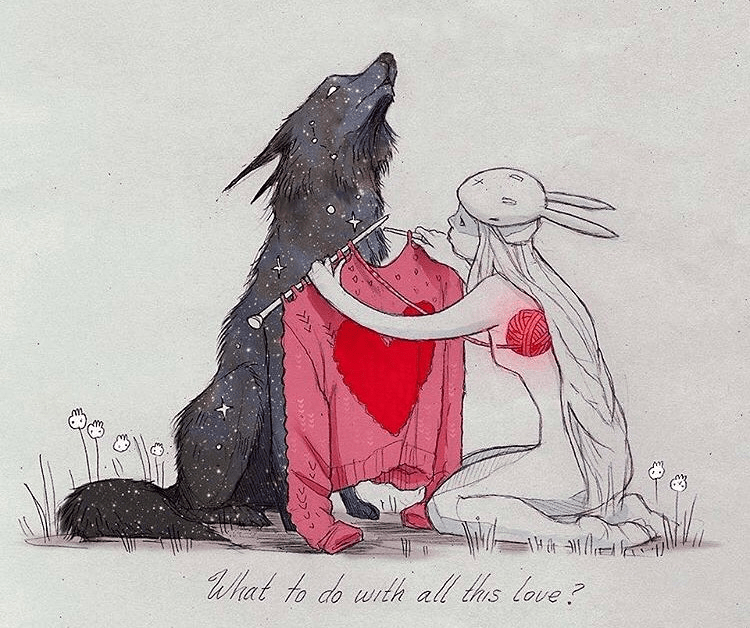
Although this piece didn’t exist when I first began feeling the inner urge to help living beings, whether human or animal, the question was already dwelling within me.
For me, it was completely normal to love so strongly. To others, it was “too much.” I remember a Facebook comment under an animal rescue post from a friend. He was on the opposite side of me when it came to empathy, and probably triggered by the post, he said: “You’re a pathological empath.” To ensure I responded with equal immaturity, I replied that I’d rather be that than a borderline sociopath. Oh, what a powerful and highly intelligent discourse that must have been in the eyes of the Facebook audience! If God were judgmental and sarcastic, I’m sure He would’ve face-palmed and written “My two geniuses” under our brilliant conversation.
Fast forward ten years, and both my friend and I are neither pathological nor borderline. We’re millennials who’ve grown into two understanding, caring adults who’ve learned to set boundaries. This led me to think about the concept of selective empathy.
It focuses on—just as the name suggests—the selection of whom one wants or should empathize with. For many people, it’s easier to walk in someone’s shoes if they’ve experienced something similar. Nothing new under the sun, right? But what happens when someone chooses to empathize only with those who belong to their inner circle, like friends, family, or a specific group they identify with?
When I think about selective empathy in practice, I see it as a privilege that allows one to ignore the suffering of many, in favor of living protected from reality.
I realized this only after spending time with people who displayed this kind of empathy. I could share the most heart-wrenching story, and the closest they’d come to compassion was a startled smirk and a nearly indifferent, “Well, what can you do…” However, if someone close to them was going through a painful situation, they’d soften and show pity.
But how can one know the depth of their kindness and strength if they never step beyond their self-imposed limits? How can one understand humanity and be truly human if they avoid what makes them human?

One of the most shocking experiences I had (and I think “shocking” is an understatement) was when my partner and I lost one of our closest friends to suicide. I was still grieving the loss of my best friend eleven months earlier. We were at a loss for words. And when you’re lost for words, you hope someone else will have the right ones—that someone will at least try to understand your sorrow.
What we encountered was a disgraceful contradiction. People from our closest circle, almost with judgment in their voices, commented, “What’s with all the crying? You can’t act like that. Life will still bring hard things. Pull yourself together a little.”
Left in disbelief, I purposefully dissociated, hearing fragments of the ongoing conversation, which sounded like someone dissecting a bird to understand the cause of its death.
A few months later, I met with a friend and confided in her about the loss. Her reaction was flat and almost cynical, as if I had just told her that someone left their job.
These razor-sharp disappointments were interrupted by the actions of two kind souls. A few months later, I met with two different friends. They didn’t break into tears, but I could easily see the compassion in their eyes and voices. They were thoughtful, great listeners, and shared intelligent observations. No judgment. No speculations. No cynicism. Their approach was honest, warm, and supportive. It felt as though they were trying to understand my friend’s invisible pain and telling him, “You were loved.” That mattered to me more than anything in the world.
This experience led me to explore, learn, and understand empathy as a specific, isolated ability. I began with self-observation, introspection, and self-questioning. How can I become a better friend? Have I been too this or too that? Can I use my deeply ingrained empathy in a more useful way?
Only to realize that the first few reactions weren’t necessarily a lack of emotional intelligence. They were a choice, which I can understand to some extent. People don’t want to experience negative or heavy emotions. They don’t want to tumble their minds and souls in someone else’s emotional dust. Feeling for someone requires effort, resilience, and dedication. Most of all, it requires listening and being present. And many people would rather talk about themselves than listen to others.
Then I thought of God’s character. How would He react? In spite of what many religious institutions like to portray Him as—the scary, always judging, angry spirit—I know that He is the opposite. As much as I was left with a big “Why?” in me, I never felt anger toward Him. Because He is the One Who taught me compassion. He is the One Who created us to feel, to love, to mourn, and to be there for each other.
And if you ever have doubts about that, or haven’t met Him yet, do remember this:
“Jesus wept.”
— John 11:35

Song of the day: Marching In Time – Tremonti
Hidden gem of the day: Blessed are Those Who – The Chosen
Worth watching: Carl Rogers Defines Empathy
Perspective:

Ellen Hendriksen on how to empathize without burning out
Knowledge of the day:
Types of empathy
Cognitive
Being able to grasp someone’s situation and understand how they feel through knowledge and logic. In other words, you can understand someone through reasoning, and not as much as feeling.
Emotional
Emotional empathy is empathy experienced through emotions. You can physically experience the feelings of the person you empathize with, or as we like to say, “walk in someone else’s shoes.”
Compassionate (conservative)
Compassionate empathy is not just feeling what the other person feels, but also the ability to act and be willing to help. Unlike cognitive or emotional empathy, which involves intellectual understanding and emotional support, compassionate empathy pushes us toward finding a solution and offering relief to the person suffering.

 Zebras and Magpies
Leave a comment