


I never understood envy. I’m talking about the envy that comes with a hostile stare and belittling. Feeling happiness for one’s misfortune. Setting traps and provoking sadness and distress in others.
Whenever I try to understand someone’s envy, I have to push over my discomfort. I dissect a person’s bitter attitude towards me and replay the situation, only to see where it comes from. No matter how deep I go, I can never fully grasp and justify its depth.

I’ve tried to think of times when I’ve felt envy and realized I would have to invent such a moment.
I’ve experienced a large piece of negative emotions. I’ve felt frustration, guilt, inadequacy, disappointment, shame, insecurity, sadness and desperation. I’ve bowed to anger. Oh, I almost gave it a crown while thinking I was having it under control. It took me one after another severe breakdown to understand the amount of anger I’ve carried for years.
Most of these feelings, however, I was directing towards myself.
Envy has never had a home in my soul. It has never been part of my character.
Maybe because it’s the one emotion that I find so repulsive. Or maybe I have never been envious because God made me and taught me otherwise. I just wasn’t aware of it.
When I was seven years old, my father asked me if I would like to become an actress, telling me all the pros of life in front of cameras. A sharpshooter with words as I am, I firmly refused the idea with a simple “No.”
“Why?”, he asked with a warm smile on his face.
“Because that way, I would never be myself. I would always have to live someone else’s life.”
He and my mom, half-surprised, looked at each other and smiled.
As a child, I suppose I had no clue about the depth of my declaration nor that it would cause me a lot of turbulence in life.
Today, when I think of my response, I see uprightness. I notice the same firmness in my nephew and my friends’ kids. They aren’t afraid to be honest, righteous and persistent (often perceived as manipulative, stubborn and disobedient).
In many grown ups, it’s the opposite. Adults easily compromise themselves. They tend to lean towards fear the moment they come near an obstacle. They easily fall into the trap of conforming and—to their regret—lose their self-esteem.
I believe that envy begins the moment self-consciousness and self-esteem die. A person completely abandons themselves for the sake of social recognition or conflict avoidance.
Whenever I meet an envious person, I try to balance things out. I know there are probably layers of insecurity, suppressed freedom in childhood and mostly, fear.
Is this enough to justify one’s malicious acts? Not at all.
I recently read a study on envy that says social comparison is a fundamental element of human cognition, and that’s why people, by regularly comparing themselves to others, experience envy. Nothing that we don’t know of, right?
The question is, how does one end on the extreme side of envy, turning into an evil, selfish and a sadist person?
In her essay, “The Other Six Deadly Sins,” Dorothy Sayers says there are two levels of envy; it either moves up or down.
In other words, if one person compares themselves to someone else, they can try to become like them and gain what that person has. If they can’t do it, they will try to take that person down.
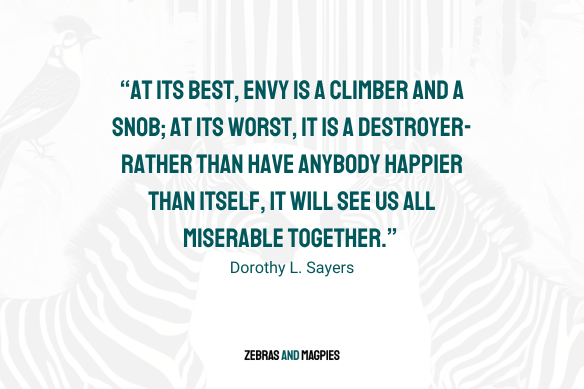
Psychologists explain this as two types of envy: benign and malign (malicious). Benign envy motivates the envious to upgrade their status through self-improving acts. Malign envy is directed towards the envied one and is characterized by hostility; the envious wants to cause damage to who they perceive as better and more successful than them.
Envy also has a lot to do with self-control. Those with low self-control are more prone to try to bring someone down and cause damage, because it’s easier for them to bring someone down to their level rather than climb up.
From a scientific point of view, there is a degree to which I can understand the origin of envy. From a spiritual and a human perspective, I refuse to normalize it just because it’s part of being a human. Intentional, malicious envy is sinful, it’s damaging and destructive, and an offering to continuous evil.
There is always a better alternative to changing what you think you can’t change. Asking for help. Self-care and self-acceptance. Learning and unlearning. Acts that show you have self-respect and you’re willing to work on your improvement.
There is also kindness. It builds up. It nourishes. It attracts good things. It leads to a calm life. It transforms you, and teaches you how to help transform other lives. Without controlling. Without manipulating. Without running after a throne of evil.
God gives us free will. It’s on us to choose whether we’re going to go the wide or the narrow way.
The wide way may seem attractive, but it’s on the narrow way where we can heal our souls and learn to love ourselves without hurting others.
Song of the day: Love Can Only Heal – Myles Kennedy
 Zebras and Magpies